Weaned from Personal Preference, Enchanted by Grace
In a culture shaped by personal preference and digital fragmentation, what does it mean to live by grace? This reflection explores why the Christian vision of grace feels so foreign today and why it matters more than ever
I have been curious about how challenging it is to centre on grace, a graciousness with others, reflecting something of the grace we have in Christ, both in myself and around me. There is an ongoing, pervasive cultural formation happening in our time that has little room for grace.
We are being shaped to believe that freedom is found in choice, identity in preference, and belonging in alignment. We curate our lives, refine our views, and learn—often unconsciously—to see the world through the lens of what we agree with, what we value, and what we are willing to stand against.
This is not simply cultural change. It is a discipleship subtly promoted in our age.
In this time, many of us are formed by market logic and digital culture, we are trained to become careful managers of the self—developing skills, maintaining relevance, and presenting a coherent identity. Social media amplifies this, forming us into reactive and often fragmented communities of opinion, where conviction can become performance and disagreement can become division.
The result, in the end, hasn't done well by honouring difference and diversity, but it has fostered fragmentation.
And in this environment, preference begins to carry more weight than almost anything else.
The deeper shift
The Canadian philosopher Charles Taylor describes our cultural moment as living within an immanent frame—a way of understanding life largely closed to transcendence. God is not necessarily denied, but God is no longer required to make sense of the world.
Within this frame, something subtle happens.
We begin to see ourselves less as creatures held in God’s grace and mercy, and more as individuals responsible for constructing meaning, identity, and purpose. Life becomes something we assemble rather than something we receive as gift.
This brings a certain kind of freedom. But it also brings a greater burden of self-focused responsibility without wider transcendence or even inter-dependence.
If everything depends on us—our choices, our direction, our sense of self—then the weight of life rests heavily on our own capacity to sustain and develop it as individuals.
It is no surprise that many feel both free and fatigued, and when things can't be self-sustaining, the guilt and frustration can turn on oneself.
A longing beneath the surface
At the same time, there are signs of a deeper longing.
Even as institutional religious affiliation declines in many western cultures, many—particularly younger Australians—remain open to spirituality, meaning, and purpose. There is a hunger for belonging that goes beyond preference, and for hope that is more substantial than optimism.
This suggests something important.
We are not simply witnessing a loss of faith.
Many are seeking a deeper, more grounded way of being human.
Grace interrupts the logic of preference
Into this landscape, the Christian gospel speaks with a strange voice—not by offering another option to choose, but by proclaiming grace in Christ.
Grace is not sentiment. It is not vague kindness. It is not doing good. It is gift of God.
This is confronting.
Because it means grace does not operate within the logic we know so well:
- it is not earned
- it is not deserved
- it is not secured through performance
Grace is given.
And because it is given, it does something that preference cannot do:
it creates a people, it creates a people of God.
The shape of grace is Christ
Grace is not abstract. It is revealed in Jesus Christ. In Christ’s life and teaching, and as the crucified, risen One of God.
In Philippians 2, Christ is described as the one who does not grasp at status, but empties himself—taking the form of a servant and giving himself in love. This is grace as self-giving, reconciling love, for the sake of reconciling the world.
It is a strange vision in our time.
In a culture shaped by competition, Christ does not compete.
In a culture shaped by self-protection, Christ gives himself.
In a culture shaped by status, Christ descends to serve the world.
And in the teaching of Jesus—particularly in the Sermon on the Mount—we see this grace embodied:
- love for enemies
- generosity without return
- trust in God rather than anxious accumulation
- a life oriented toward God’s kin(g)dom
This is not a refinement of preference. It is a reorientation of life.
Why grace feels unfamiliar
Grace can feel foreign today because it runs against the dominant assumptions of our culture.
Grace does not reward the strongest.
Grace does not reinforce tribal or national boundaries.
Grace does not seek visibility or recognition.
Grace does not centre the self as the hero.
Instead, grace reconciles all held captive by sin and injustice, gathers us into one body, and transforms us all.
This is why Christian faith can appear, at times, a little strange.
Not because it is disconnected from the world, but because it invites us to live differently within it.
Grace, justice, and being present with
It is important to say clearly: grace does not silence sin or injustice.
Grace is not passive. It does not ignore the intentions of the human heart to control, in subordination of others, it does not ignore harm and sin, overlook inequality, or dismiss the lived experiences of those who are marginalised. The Scriptures consistently witness to a God who hears the cry of the oppressed and calls for justice, mercy, and humility.
In our time, we are increasingly aware of the ways injustice is experienced across overlapping realities—race, gender, culture, class, ability, demographics, locations and more. These intersecting experiences matter. They name real histories, real exclusion, and real pain.
Grace never silences this, but transforms it, as John Newton, composer of Amazing Grace, witnesses, from being a slave trader to being transformed by grace, and then spends his life as a voice seeking to dismantle the slave trade in the UK.
Grace does not conform to the fragmented patterns that surround us—patterns in which suffering and the diminishment of human dignity are rationalised by economic interests or supremacist ideologies. Instead, grace draws us into the Kin(g)dom of God, where such distortions find no home in Christ. Yet in an age of hyper-individualism, grace is often reduced to something to be measured, defended, or contested, rather than received as gift and shared in relationship.
Grace offers something deeper.
Grace creates space for us to move beyond defending own normative preferences and assumptions, not by erasing difference, but by calling us into relationship. It invites us to be present with, rather than to compete against; to listen before responding; to stand alongside rather than speak over.
In Christ, grace is embodied. It draws near. It bears the weight of suffering. It refuses both indifference and domination.
For the church, this means:
- attentive listening
- truthful naming of injustice
- solidarity with those who are marginalised
- and a commitment to seek justice without losing sight of reconciliation
Grace holds together what our culture often pulls apart: truth and mercy, justice and relationship, difference and belonging.
It refuses to let division have the final word.
A community shaped by grace
If grace is truly gift, then it reshapes how we live.
We begin to understand ourselves not as self-made individuals, but as people held in God’s love and justice, where all life is honoured as a gift of God. We discover that we belong not through alignment or agreement, but through reconciliation in Christ with the divine and each other.
This has implications for how we live together:
- we forgive where others would divide
- we share where others would accumulate
- we tell the truth without turning the truth into a weapon
- we remain in relationship where others withdraw and divide
You see, Grace is not only believed. It is embodied.
It is seen in communities that hold together difference, practise hospitality, and reflect—even imperfectly—the reconciling life of God.
This is part of the calling of the Uniting Church: to be a pilgrim people, shaped not by the patterns of the world, but by the grace we have received in the crucified, risen One.
Beyond fragmentation
In a time marked by division and fragmentation and reaction politics, grace offers a different way.
It does not deny difference. But it refuses to reduce others to enemies.
It does not avoid truth. But it resists turning truth into a tool of exclusion and exploitation.
It does not seek uniformity. But it forms a deeper unity grounded in Christ.
This kind of life requires formation in Christian community. It requires patience. It requires communities willing to be shaped by grace over time.
Grace is the gift of God witnessed to in Christian community.
The invitation
The gospel does not invite us to choose another preference. It invites us to receive grace.
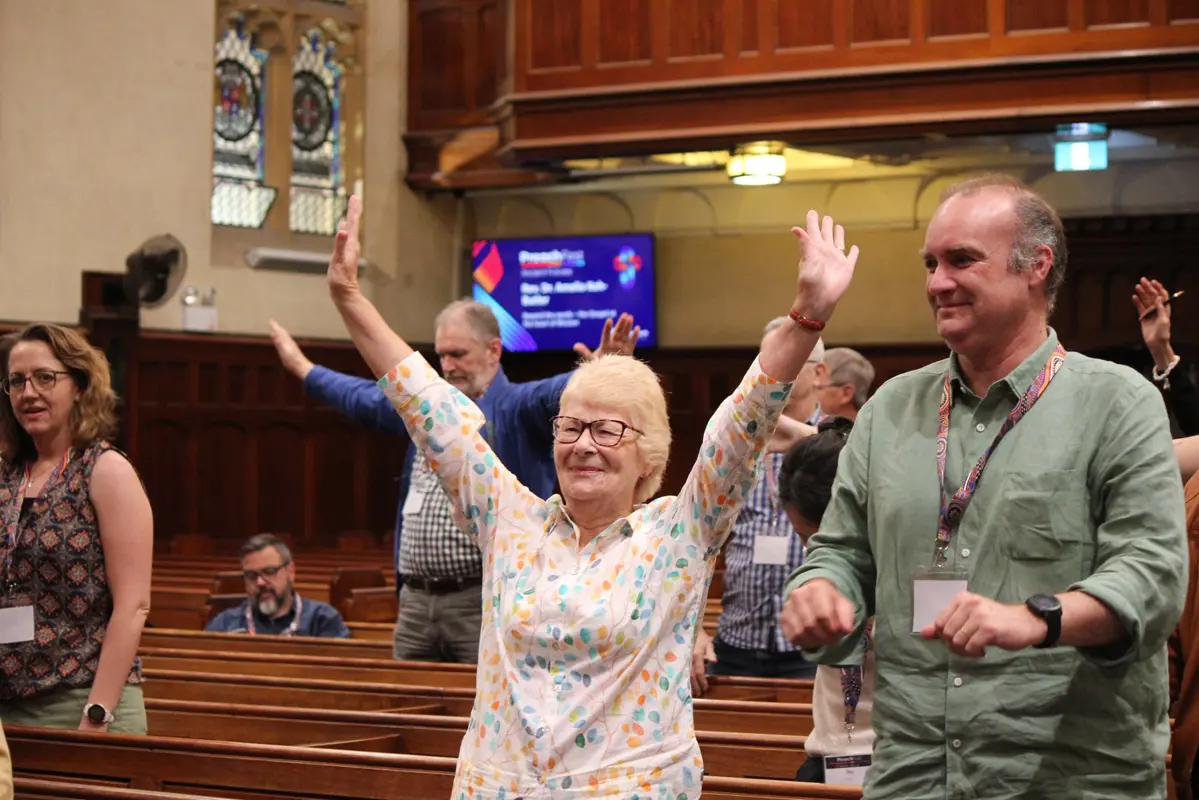
Grace creates space to move beyond defending our own preferences — not by erasing difference, but by calling us into relationship.